As a writer, I believe I am not alone in feeling that while "in the zone" of writing there is nothing I would rather be doing. But it is a lonely process. Some writers welcome this, even develop character traits that ensure their being left alone. They develop eccentricities, curmudgeonly-ness, even plainly anti-social behavior. But there are authors and some aspects of writing that improve with fellowship. That is why many authors thrive in academia or in writers' retreats. That is also why writers have gravitated towards communities of which "The Village" and Montmatre are the most cliched examples of creativity fueled by shared consumption of caffeine or absinthe or whatever.
In the brave new world we now inhabit, the "Matrix" can provide some substitutes. I wrote in
an earlier post about the gathering of reviews. This is something that a writer lives for; it is the equivalent of applause for actors, musicians, street entertainers, and others who perform. Even a negative review is better than being ignored. Well, the website Goodreads.com contains many Groups that feed this authorial need. These Groups provide the key to this sprawling web-site; search the groups for genre (Cozy Mysteries) or purpose (Indie Writers/Review Group) and you will find groups that provide reviews and other support for Romance, Science Fiction, Inspirational or Spiritual works, novellas for children or New Adults, Mysteries and Thrillers, Post-Apocalyptic Zombie adventures, Travel, Health, and so on. Or you can look up an author, for example yours truly, and see what books he/she has written and the reviews and comments that any of them have attracted. Link to Goodreads
Prior to publication, authors often seek the opinions of others. There are those, no
doubt, from whose heads the novels have sprung fully formed, like Athena from Zeus' head, but lesser mortals need the comfort of the opinions of their fellows. Publishing sites like Createspace usually have a section devoted to "Previews" of works in progress, but these pale in comparison to Authonomy.com. Like Goodreads, this site works on the principle of reciprocity. Authors who wish to benefit from them must show a willingness to contribute to them. Is that too much to ask for? Read and comment on the work of others as you would have others read and comment on your work in progress. With a blush, I offer a look at a new writing project I have undertaken--Agamemnon Must Die. As you can see, I have uploaded a portion of this work in progress (minimum of 10,000 words) and comments follow led perhaps by one's comments on the work of others but also by who else has commented, the web equivalent of "word of mouth."
Authors who are born to write in solitude need not apply, but for the rest of us, I hope these leads are helpful.
Monday, November 18, 2013
Sunday, November 10, 2013
Getting Help
I had lost count of the number of times I read, re-read and edited The Battle of Chibi,
published in 2010. There are several proofs still on my shelves and I see one or two with edits in different colored pencil marks to indicate attempts on separate occasions to correct errors or improve the flow of the narrative. It was a process that took months and left me exhausted, and as I considered the publication of the Spymaster, I shuddered.
Hence I decided to treat myself to professional copy-editing and proofreading as well as to a real graphic artist for the cover. This saved my sanity and I am pleased with the results, even though I did not behave well as a patient and did not take all the medicine prescribed. Those involved with me in this process were, fortunately for me, professionals and took my recalcitrance in stride.
This is undoubtedly an issue for all who self-publish; we like to call ourselves Indie authors. The services that the publishing houses provide are worth their weight in gold, without a doubt. The doors are accordingly well-guarded. Hence for those not so privileged, I highly recommend looking around for professional help.
If money is no object, then one should not think twice. Consider how off-putting typos, grammatical errors and wrong words are. Consider too the pride of authorship. Fortunately, there are many highly qualified graphics artists, editors and proofreaders who do not charge what they are worth. I would not want to publish anything without a professional proofreading and for anything over a hundred pages I would want both copy-editing and proofreading by professionals. Naturally, one should also get a professional cover, even though I think that for The Battle of Chibi looks reasonably good for having been created using a online publisher's template.
Wednesday, October 16, 2013
Collecting kudos
I'm cheating somewhat by reproducing three reviews of Heaven is High and the Emperor Far Away, A Play as this post. But I do so in part to highlight one of the many resources a writer now has to find support while writing and, having written, to promote his or her work. The following three reviews are from Goodreads.com, a wonderful site in which to find resources while writing and then to make written work available for reviews.
On July 13, 2013, Zrinka Jelic author of Love Remains (July 2013) wrote:
It took me a few pages to get into the feel of the book, but once I settled into this style I found it an enjoyable read. I'm sure there are guidelines for writing the play, but I'm not familiar with those and therefore won't review the writing itself.
The developments of the plot are giving us a clear message how reform, revolution and the change only makes things worse in the long run. If the progress is to happen, it will happen naturally at its own pace not forced by someone's beliefs and guns. The story line reminded me of an Croatian TV series that follows the little barber shop before, through, between and shortly after the two world wars. The barber's main line was "I won't tolerate politics in my shop." Yet, politics was all that was talked about. Same in the Teahouse, the owner put up signs about not discussing the politics, yet the developments in the country was the only thing on people's mind.
I would love to see this onstage. Perhaps it'd be less confusing with the lines for actors clues and cues and the kind of voice they should say the lines.
I understand that this is a translation into English, but perhaps some different words should have been chosen. For instance eunuch, the dictionary tells us it is "a man who has been castrated, esp (formerly) for some office such as a guard in a harem" Yet in this story eunuch, from what I gathered, was a man of wealth and influence who had as it was implied used a then young girl to present her as his child bride. I found this a bit confusing, but contributed it to being lost in translation.
All in all, this was a good and entertaining read.
Tani Mura on September 6, wrote:
This is a short play about a shopkeeper, his tea house, and his family and friends as he struggles through political change, economic woes, and societal immoralities in a China not so long ago.
This was a very enjoyable and light read. Translating and adapting an original work is difficult, and delivering a play in an interesting and accessible format is quite a challenge, but I think the author did a fabulous job of balancing historical context, dialogue, and stage direction to assist the reader in conjuring up an image of the play in his or her head.
The preface was extremely helpful, not only because it set up the political and social environments in which this play unfolds, but also because it allowed for some of the author’s voice to come out. Favorite quote: “Heaven is high and the Emperor is far away was a familiar saying in the provinces of China…It reflects the sense that human ideals are quite remote from out mundane reality.” The author has a knack for elegant yet not overly embellished writing, and this preface contrasted well with the simplicity of the play itself.
Of course, because this is meant to be a play, and we as readers aren’t able to see the actors’ facial expression, catch their subtle motions, or hear the anguish or laughter in their voice, much of it is left to the readers’ imagination. For those who are seeking descriptive character development and a detailed plot, you may not enjoy this as much. But for me – an avid reader who appreciates when books leave a lot of room for the readers’ own imagination – this was a very enjoyable read.
Then most recently on October 8, Peter Stone opined:
'Heaven Is High and the Emperor Far Away, a Play' by Hock G. Tjoa, was a most enjoyable and informative read of a most tragic period of Chinese history, of a time when China was recovering from the ravages committed by the Japanese army during World War Two, only to plunge into the civil war as the Communists rose to power. The play gives us a glimpse of everyday life in this time, by letting us experience it through the goings on within a teahouse that had survived decades of power struggles and wars.
I felt very sorry for the shopkeeper as he poured his life and years into the teahouse, only for the vultures of a corrupt government take advantage of him time after time. I lost count of how many times he had to fork out bribes, to cops, agents, and others, just to keep in business or to keep them away from his customers.
And all the while the shopkeeper is preparing to re-open the teahouse. As I read I began to wonder if he would even be able to re-open the teahouse before running out of money. There is a broad spectrum of characters, from many walks of life, and watching them interact with each other is a treat.
Disclaimer - I was provided a copy of the play by the author for an unbiased review.
======
I trust readers will follow the link in the first paragraph to see other reviews and also to explore the world of Goodreads for themselves. Amazon has recently purchased that site but what that means is unclear to me. Sharp-eyed readers will also notice that I have changed the background color of the cover from a rosy pink to a golden yellow; this is now easily done on a site such as Createspace through which I published both the paperback and Kindle version of this play. Chalk it up to modern technology!
Wednesday, October 2, 2013
Deng Xiaoping and Liberal Democracy
Reading this large but absorbing tome leaves one with the sense that Vogel wished Deng had brought China closer to liberal democracy, in the same fashion as old school biographers of Gandhi conveyed the chimes of a pious wish that he had become a Christian. Neither eventuality was ever "in the cards." One suspects that many reviewers of Vogel's work are critical also of the author for "going easy" on Deng for the very same reason.
Though it looms large in current international relations, liberal democracy has very shallow roots. One cannot accuse the British Empire, for instance, of having tried to make the world safe for democracy; it was trying to make it safe for the British pound. Not until well into the twentieth century can liberal democracy be said even to exist. The international megaphone meanwhile has been passed on. As western democracies were/are refining their notions of liberal democracy, dozens of other countries were/are struggling simply to be free, from their past and from their recent colonial overlords. It seems suspicious that these former overlords should require of India, China and the dozens of nations that came into being around the middle of the twentieth century that their politics be conducted as if by Westernized Oriental Gentlemen.
John Locke can be said to have laid the foundation for such a philosophy of political behavior
or government, but it is useful to remember that he did much of his thinking in the comfort of the palatial residence of the Earl of Shaftesbury whom he served as personal physician. The notion elaborated in the Second Treatise on Government that civil society should have the liberty and legitimacy to overthrow a (royal) government that had grown tyrannical formed the rationale for the Glorious Revolution of 1688. England deposed one king and adopted another with some sort of understanding that the new monarch would get along better with the nobility and landed gentry. Locke would have been horrified to see his ideas pressed into the service of the American revolution as it was (as brilliantly argued by Louis Hartz in 1955) and would probably be spinning in his grave about the Irish being given any kind of democracy. What he would have thought about Margaret Thatcher's successful attempt at re-establishing British liberal democracy in the Falklands (what did she or the world think was going to happen to the Islands under Argentine rule?) and failed attempt to maintain it in Hong Kong, it is best not to speculate.
But India, China and other nations though new as nations are not so new as cultures or civilizations. They developed not besotted with the belief that "all that is, is right," nor that Progress was "historically inevitable," nor that as such it would lead to liberal democracy. In China, the essence of political legitimacy was to maintain order and prosperity such that even though enough is known about neighboring countries, its own people would have no interest to visit their neighbors. When Deng was confronted with the dramatic escapes from China to Hong Kong, his reaction was not to preach liberal democracy (which might have recommended walls of razor wire) but economic development.
Is this cultural difference tantamount to a "clash of civilizations"? I seriously doubt it. Huntington's essay was occasioned by the work of a former student who wrote The End of History, an explication of Hegel's notion (one Marx approved of) that nation-states would inevitably wither away. If so, what would we ever fight over? From the point of view of an American political scientist in the 1990s, cultural values, of course. Alas, nation-states do not appear to be in any hurry to wither away. Further, conflict arises not discernibly because of cultural differences; it seems more likely to be the case when there is a bully in the schoolyard.
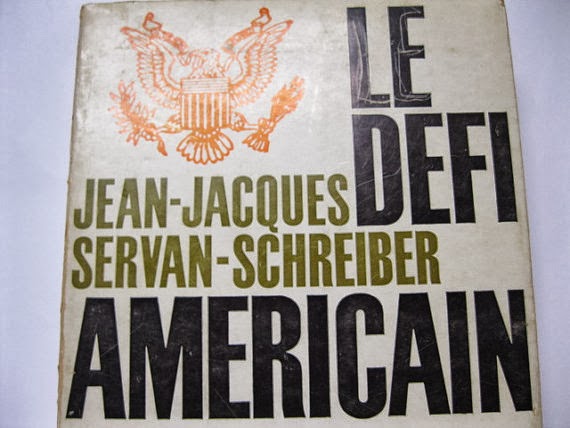
Ten years before Ayatollah Khomeni referred to the United States as "the Great Satan," pundits were agog with Servan-Schreiber's Le Defi Americain. Perhaps that was simply Gallic nerve. Then came Shintaro Ishihara's The Japan that can say No. He was deemed a ultra-nationalist crank. What do pundits think a poll of European and South American states today would reveal?
We can all hope that the nation-states of the world spare some consideration for economic prosperity whether or not they are also thinking of liberal democracy or worried about the schoolyard bully.
Friday, July 19, 2013
Literary "crunches"
Many years ago,
perhaps a few decades now, I found that reading some pages of Fowler’s Modern
English Usage would provide a boost to literary activity much as doing twenty-five
jumping jacks and/or stomach crunches might get my heart rate up. Alas, Fowler’s
became increasingly out of date and the many worthy new editions did not have
the same combination of snap and gravitas to do the trick.
I am happy to
report that I have found a substitute; it is Francine Prose’s Reading Like a Writer: a guide for people who love books and for
those who want to write them. Prose is herself a writer of fiction and though
I must confess I do not agree with all her suggestions for books “to be read
immediately,” I am pleased to find that I heartily concur with her
recommendation of many. These books and others provide illustrations for the
wise advice that she has for writers. There is much humor also in this book.
On sentences, for
instance, she tells the story of a young author who has lunch with a “super-agent.”
They discuss the writer’s ambitions and, when the writer confesses that he is
not interested in genres so much as he is in writing beautiful sentences, the
agent pauses for a longish time. “Never,” he finally says, “tell this to any
publisher.”
Prose also advises that writers occasionally read their work out
loud, a practice common among the gentry before mass entertainment trashed the amateur
efforts of guests at country homes to entertain themselves, to become aware of
the cadence, the rhythm of one’s sentences.
The catholicity of
her taste and sources is indicated by her choice of examples. For paragraphs,
she selects, among others, Isaac Babel and Rex Stout. "A new paragraph is a wonderful thing," said Babel. "It lets you quietly change the rhythm, and it can be like a flash of lightning that shows the same landscape from a different aspect." Prose adds that paragraphs are very much like breaths; they are the natural places/times to inhale or exhale.
From Rex Stout, via Nero Wolfe, comes this observation: "Paragraphing--the decision whether to take short hops or long ones, and whether to hop in the middle of a thought or action or to finish it first--that comes from instinct, from the depths of personality." Thus paragraphing is as peculiar to an individual writer as his or her fingerprint. Some authors are loath to make paragraph breaks, most famously Gabriel Garcia Marquez, whose Autumn of the Patriarch is written in a single paragraph.
Finally, for this was never intended to be a condensation of all that Prose has to teach a writer, the source that brought Babel's thoughts on paragraphs to us also found him with a high stack of handwritten pages on his desk; was the master of the short story finally going to write a novel? Not at all. The stack represented revisions of his latest short story, all twenty-two of them.
Saturday, June 22, 2013
Cozy Mysteries
Given the flood of dark, often sadistic, noir mysteries, I have turned for relief to the "cozies." One thinks at once of Agatha Christie whose Mysterious Affair at Styles published in 1920 introduced to the world Hercule Poirot. Lovers of the cozies who are purists tend to stick with the novels that feature Miss Marple. But it is Poirot, Chief Inspector Japp and the useful Captain Hastings (who narrates this story) that are the first of Christie's creations. It is an inspired combination of the slightly ridiculous Belgian detective so full of himself and his waxed mustache with the ever helpful Hastings to drive Monsieur around together with the very epitome of Englishness in Inspector Japp of Scotland Yard. No doubt some version of his character is associated with continental visions of "le roast beef."

Americans can be proud of the Cat Who series created by Lillian Jackson Braun. The first of these, The Cat Who Could Read Backwards, was published in 1966. Because all the stories were set in the same (mid-western) small town with more or less the same characters (no exotic settings or characters for Braun), readers can look forward to a new Cat Who with the comfort and anticipation that one feels when going home from a vacation abroad or a long weekend down the road. Together with other familiar toilers in the field of cozies, particularly Jessica Fletcher of Murder, She Wrote fame (although a TV series, these stories also were mostly set in the same small New England town of Cabot Cove), the cozies seemed to be a female preserve which would be fitting for its kinder, gentler approach to solving crimes. Perhaps that also accounts for the preference for Miss Marple, but one would be crazy to exclude the Poirot stories.

So too, I say, it would be insane to exclude Rex Stout's marvelous Nero Wolfe with his seventh of a ton avoirdupois, personal chef and personal gardener and orchid collection (I don't recall any reference at all to cymbidiums). Like Poirot, Wolfe had a male assistant, Archie Goodwin who introduces himself several times quite amiably as Wolfe's Man Friday-Saturday-Sunday-Monday-Tuesday-Wednesday-and-Thursday. Stout's Fer de Lance initiated his series in 1934. I am happy to say that one need not be ashamed to be reading Rex Stout these days. There seem to be web-sites devoted to keeping alive his work as well as related trivia.
All this is not to argue that tastes do not or should not change. The Girl Who series that made such an impact on the reading world a couple of years ago were absolutely brilliant writing. They should persuade any who need persuading that there is real evil in this world. Then we discovered that there is an entire universe of Scandinavian noir. At the same time, American TV seems to be inundated with police "procedurals", series on crime scene investigations or special units investigating heinous crimes as well as gory paranormal events.
I confess that my mind craves balance as well as authenticity. It rebels against the flood of noir mysteries as it does against spy novels full of vengeance or populated by self-righteous super heroes, even those who are rule-breakers because their motives are higher and purer. Perhaps I should admit that my prejudice is ESPECIALLY against those who believe their motives are higher and purer. Neither human society nor civilization itself is well served by the glorification of such characters. Just saying.
Wednesday, May 22, 2013
Writing dialog
May 22, 2013
First, a clarification: Some people blog every day, and it is widely recommended that bloggers do so at least once a week. I must confess that I find once a month challenging. Twitter gets maybe one a week from me, so.... At any rate, I am sure those who follow or visit this blog have other sources of entertainment.
This blog is also a break from the build-up I have tried to give to the publication of The Chinese Spymaster, expected this summer. This blog does continue on the theme of a writer's education. I found in writing (translating and selecting) The Battle of Chibi that there were many passages that included dialog and thought it odd that some translations minimized this. At any rate, to coincide with the appearance of a (slightly) revised version of "Heaven is High and the Emperor is Far Away, a Play," my translation and adaptation of Lao She's Teahouse, I offer this blog on writing dialog. Following is the "proof" of the cover from Createspace:
First, dialog should not, in my view, mean that the rules of good grammar and spelling are suspended. Some authors seem to believe that this leads to inauthentic language. I think the true challenge in writing dialog is to write to the highest standards of correctness one can within the limits of credibility. The original Mandarin of Teahouse was, one is informed, an accurate rendering of Beijing dialect. I have no idea how to convey that in English and therefore chose to write the dialog as "standard English" with a few exclamations--"wah" and "ai-ya"--that I hope act as sign-posts that the play does not take place, say, in Kansas.
I hasten to add that I would not wish to change a single syllable of Faulkner or Twain or Joyce, but my own modest thought about this is that there is entirely too much bad "dialect," that it is best left to experts, and that it is actually easier to write standard English.
As much as possible, dialog also enables the writer to show rather than to tell. This is not always the case as even in real life we gossip and exchange news in indirect speech. Friends get together and discuss, for example, the passing of some custom, practice, or of some other friend. But generally dialog enables the writer to show people arguing and quarreling as opposed to telling us about it. For writers, it is generally accepted that this is a good thing.
Dramatic dialog has the added requirement that it carries on at a good pace. Those who write plays and have watched them performed cringe at moments of "dead air." Often such moments can be covered up by more or less antic stage "business." But it is best that the dialog be crisply written (and that the actors remember their lines).
Like all writing, dialog should contribute to some point of the story whether this is the development of a character, the detailing of a plot element or the depiction of some action. Fellow writers who have difficulty with dialog are encouraged to try writing or adapting a play to get the appropriate workout.
(Details on purchasing the new revised version of "Heaven is High" may be found under the appropriate tab of this blog.)
Subscribe to:
Posts (Atom)
Our Story
This review first appeared in Goodreads , https://www.goodreads.com/review/show/2491467631 Rao Pingru wrote this charming "graphic nov...
-
Long ago, along a stretch of a river deep and wide but far away from the consciousness or imagination o...
-
One of the aspects of the Romance that makes it a classic is that it is not only a collection of fascinating stories, poems, battle scene...
-
This review first appeared in Goodreads , https://www.goodreads.com/review/show/2491467631 Rao Pingru wrote this charming "graphic nov...