Thursday, September 22, 2016

The Battle of Chibi - Giveaway

Ten copies of The Battle of Chibi will be given away through Goodreads. Register for one of these between September 24 and October 17. Goodreads has an algorithm that will select the winners and I will mail them out myself. Following is the  Goodreads "widget."


Goodreads Book Giveaway


The Battle of Chibi (Red Cliffs) by Hock G. Tjoa

The Battle of Chibi (Red Cliffs)

by Hock G. Tjoa


Giveaway ends October 20, 2016.

See the giveaway details
at Goodreads.


Enter Giveaway


I should say that I have personally found Goodreads a wonderful resource, organized in "groups," - fellow writers, readers, lists of editors, proofreaders, etc. One example is Goodreads Authors/Readers.It also has several groups that focus on getting reviews for independent (INDIE) authors. One that I visit often is simply called Review Group. Finally, one group that holds special memories for me is The James Mason Community Book Club.

Do visit Goodreads for your reading pleasure or writing needs.

Monday, August 22, 2016

A second edition for The Battle of Chibi

First published in 2010 with the ebook version appearing in 2012, this selection and translation from "The Romance of the Three Kingdoms" now appears in a second edition.

The format is "tidied up" as I have learned something about "how to make [MS] Word behave" mostly from the Smashwords style guide that coined the phrase and from Wordtips, a website with invaluable contributions.

I have also tweaked the writing to make the story flow better although I trembled while doing this as writing style is a highly personal matter and there is no guarantee that my "improvements" will appeal to more readers. I did take the opportunity to eliminate the errors I found on further reading and even sent my revised text for proofreading by a professional.

Perhaps the most significant changes are, firstly, the new cover as I have long felt that the 2010 and 2012 versions were too amateurish since I did them myself with the help of the templates available from Createspace. This time I used the expert design of Dawn Dominque whose website is linked. I recommend her services without reservation.

Secondly, I decided that I should purchase my own ISBN for this edition and create a different imprint for it and all my publications - SleepingDragonBooks. The reasons are technical and of interest only to writers - I shall spare the casual reader. All existing publications will migrate to this umbrella over the next months and years. Anything new will be published directly under it. The name will be recognized by those who read The Battle of Chibi or know "The Romance of the Three Kingdoms."

I have also decided to add a distributor to help get this title beyond the Amazon world, outside the United States in print and everywhere in the epub format. Ingram Spark was my choice, again for reasons that are of little interest to the casual reader. Other writers may be interested to know that there is more to be learned than one might care about the quirks of Print on Demand houses, e-book publishing, and distribution of books. Due to these difficulties, I am not able to provide a link to Ingram Spark (yet). But here is the one to the "everything store," Amazon.


Tuesday, July 26, 2016

Review of The Ninja and the Diplomat

The following is a recent review in Goodreads and Amazon of The Ninja and the Diplomat, vol. 2 of my series, The Chinese Spymaster. Volumes 1 and 2 have already been published - see the tab "Books" above; volume three is planned for end 2017, early 2018. This review by Michael Brandt is reproduced with the author's kind permission. As the writer, I am glad of any attention to my books and especially appreciative of positive reviews.

======

I knew I would enjoy this book as soon as I read "The tyranny of Aristotelian unities." This a politically rich thriller involving the intersection of weapons dealing, intelligence services, and geopolitical unrest set in multiple East Asian countries. Despite how those first two sentences must sound, this is a fast-paced story with plenty of physical action.

The writing is solid throughout, and downright masterful in parts. It is mostly purely functional, which keeps the pacing progressing rapidly. I personally would have preferred if it had slowed down and the author eased away from the functional to show some more of his flair and extend individual scenes. In this way, some smaller dramas and conflicts could be added to bring individual chapters more to life and augment the overarching one, and certain emotional scenes could be intensified. But that's a purely personal preference that not all readers would agree with.

The POV bounces between quite a few characters, some more identifiable than others. In some places I got the sense that the characters were less important than the content, which is educational and insightful. It effectively shows real and complex political issues from differing perspectives. If you prefer your politics in black-and-white and your fiction in good-versus-evil, you might not like this, but if you recognize reality then the style should appeal to you.

I was prepared to be annoyed by the inclusion of a ninja, which most media presents in a farcical caricature of reality. But to my relief, the author handles it well, providing a reasonable explanation of his presence and presentation of his abilities.

Might be a little hard for readers unfamiliar with the history and geopolitics of the region. As a former student of international relations, I found it quite interesting. The author provides a helpful map, but I still found myself wondering whether readers unfamiliar with things such as the circumstances and consequences of the American occupation of The Philippines could be thrown off.

Overall, I'd recommend this to readers who enjoy spy thrillers and anyone with even the slightest interest in Asian geopolitics.

Here is a link to the review on Goodreads
and another to the same review on Amazon

Saturday, June 11, 2016

Defending God

In the ancient Near East, when the gods detected gross impropriety in their ranks, they subjected their own to trial. When mortals suspect their gods of wrongdoing, do they have the right to put them on trial? What lies behind the human endeavor to impose moral standards of behavior on the gods? Is this effort an act of arrogance, as Kant suggested, or a means of keeping theological discourse honest?--from the book blurb.


The book with this arresting title was written (2005) by James L. Crenshaw, Robert L. Flowers Professor of Old Testament at Duke University. He is the author of many books, most recently The Psalms: An Introduction (2001) and Education in Ancient Israel: Across the Deadening Silence (1998).

In a continuing search for guidance on how to treat the issues raised by the book of Job, I had come across a reference to this tome and have tried to read it. Much of it examines ancient near eastern texts (the title of a collection by James B. Pritchard edited and published in 1950) - from Egypt, Mesopotamia, but including at least a question from Epicurus, "whence evil if there be a god?"

That I believe is the question Job and similar middle eastern texts (Akkadian, Ugaritic, Sumerian, Egyptian, among others) address. Further I believe that it is really only a "hard" question if one believes there is one god as opposed to many. Herakles /Hercules had to live with many afflictions, but I think he might have taken comfort in the knowledge that these were the doings of a jealous goddess (Hera) who intended to defy and discomfort Zeus. That was no doubt small comfort to one sent to clean out the Augean stables, but at least it meant that Father Zeus was not guilty.

What I mean is that if there are two high/ultimate powers in the universe and one was responsible for the good things that happen and the other for the bad things in human experience, then the question - how can a good God allow evil in this world - would not arise. Literally, it was the devil that did it.

The story of Job begins with a scene in heaven in which Satan or "the Satan" gets God's consent to wreak havoc in Job's life. Why then is there no further reference to Satan in the rest of the book? Neither Job, nor any of his friends, nor Yahweh when He finally speaks, refers to Satan as the origin of the evil that befalls Job. The problem of the justice or righteousness of God, theodicy, would not arise if the arguments in that book accepted the premise that there is a evil "principle" as well as a good god in the universe.


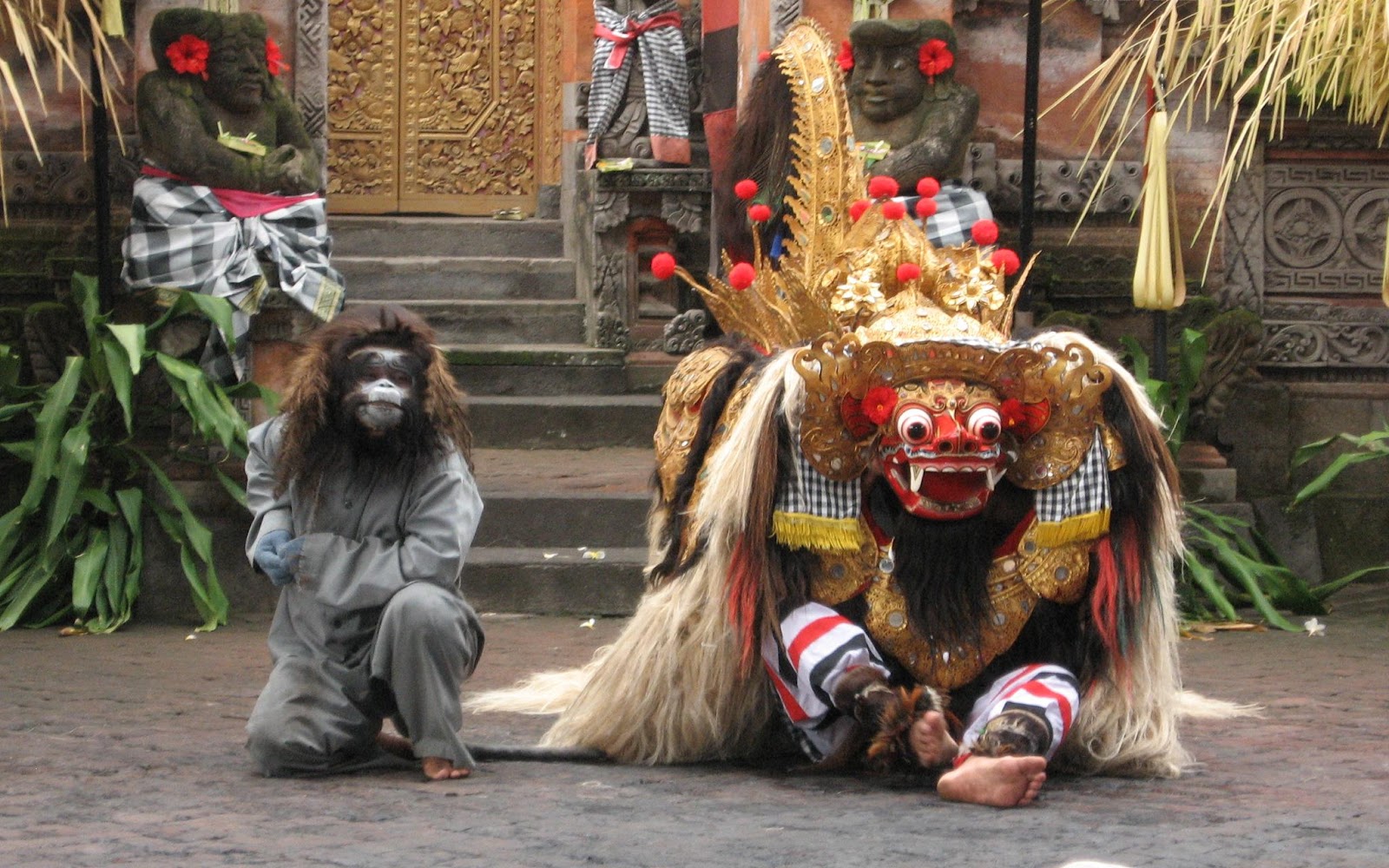
This question, therefore, is meaningless in a dualistic theology and perhaps even more so in a polytheistic context. Gods, more or less equal to each other, do good or evil as is in keeping with each character. One might even accept the conclusion of the Barong dance in which good and evil battle to a DRAW. (The image to the right was downloaded from Wikimedia Commons on June 11, 2016; this work has been released into the public domain by its author, Zsolt67 at Hungarian Wikipedia.)

But Job believed in One God, holy and almighty. Any evil in the world created and sustained by that God, raises the question, "why does a good God allow evil"? There were answers of sorts in Crenshaw's work, but I take no comfort in Mesopotamian parallels or Ugaritic myths. 

I found it particularly offensive that a passage that seemed to promise further light on this question led to a foot-note that referred to a previous publication by the author. I wished the author had treated the question substantively and not as an opportunity to display his academic achievements. I hope to address Job's question in a current writing project that I plan to complete by the end of this year.


Sunday, April 24, 2016

A spy thriller for smart readers

The Wishing Shelf Book Awards
(which provided the title above as a catchy phrase I can use as well as the full report below)


This book was recently entered in The Wishing Shelf Book Awards. This is what our readers thought:

Title: The Chinese Spymaster
Author: Hock G. Tjoa
Star Rating: 4 Stars
Number of Readers: 19

Stats
Editing: 8/10
Style: 7/10
Content: 9/10
Cover: 5/10

Of the 19 readers:
12 would read another book by this author.
3 thought the cover was excellent.
7 thought the Chinese setting was the best part of the book.
7 felt the text was often a little too complex and difficult to follow.
5 felt the pacing was too slow.

Readers’ Comments


‘Behind this very simple cover is a pretty interesting spy story. The author is an academic and this shows in the style of the writing. If you enjoy the simplicity of Clive Cussler, this is not for you. There is a strong political element to the story and there is a lot of ‘telling’ and not ‘showing’, speech being sparse and a little wooden. As a result, it feels cold and reminds me of a newspaper article.’ Male reader, aged 45


‘This is a rather thoughtful book. It is NOT an action-packed thriller but I don’t think the author wants it to be. What it is, is a thoughtful, well-researched looked at political intrigue and terrorism dynamics. Where there is fighting, the author seems a little lost. Definitely for the high-brow thriller reader.’ Female reader, aged 61


‘There’s a lot of info in this story; so much so, it kills the pace. If you fancy a book which will help you to understand the complexity of Chinese government, then this is for you. If you want fast-paced adventure, try Jack Higgins.’ Male reader, aged 33


‘Very enjoyable story. I loved all the Chinese history and how cleverly the Spymaster plays the spying game.’ Female reader, aged 41


[The above is the report, "warts and all" as they say, from http://www.thewsa.co.uk/]

Saturday, March 12, 2016

Interview by Coreena


Author Interview: Hock G. Tjoa


Today I am excited to introduce Hock G. Tjoa, an eclectic author. I am partial ancient historical retellings, so can’t wait to hear more about his approach to these.
What genre(s) do you write in?
Agamemnon_MEDI started with historical fiction, specifically, the retelling of an old Chinese classic that I selected from and translated. It is the Romance of the Three Kingdoms, with 120 chapters from which I chose twenty-three. I added short paragraphs to provide transitions for the sections and chapters that I omitted. Next I tried my hand at a spy novel and thought of a trilogy set in China but involving parts of the world that would be of concern from a point of view within that country. Action/thriller types provide what seems like cheap thrills and do not strike me as realistic so I accordingly wrote The Chinese Spymaster and The Ninja and the Diplomat with more awareness of interaction with political, bureaucratic, and personal issues.
The Ingenious Judge Dee, A Play resulted from a question I asked friends about detective stories not set in the western world. I decided on writing that as a play because of an interest in community theater. I wrote Agamemnon Must Die because I had to read the Oresteia of Aeschylus in college and had been told that this was a foundation work for western civilization – but I never “got it.”
Do you have a favorite passage you have written?
I don’t know if one could call it a favorite passage when two people die, but I think of myself as not very emotional and in one scene I tried to convey the feelings at the death of two main characters in Agamemnon Must Die –
“Aigisthos, no,” cried the queen as Orestes finally found the resolve to string his bow and brought it up with an arrow expertly, instinctively, nocked. In a fluid motion, the king swung Clytemnestra behind him so that he faced Orestes. It was forty paces between the two men. The arrow, aimed at the king’s heart, was a little low and pierced his abdomen. Dark red, almost black stains spread from the wound through his chiton almost immediately.
“Kill me too,” shrieked the queen.
Moving slowly and deliberately, like one whose will was no longer his own, Orestes raised his bow a second time and shot. This time the arrow found its mark and the queen fell as bright red blood spurted from her chest and stained her tunic.
The felled couple scratched slowly and painfully along the floor and crawled into each other’s arms.
“I love you, Aigisthos,” choked the queen gamely as she struggled to find breath. “You make my toes smile.”
“More; I wanted to love you more,” wept Aigisthos, fighting vainly to hold off the dark mist that flowed inexorably to cover his eyes and cloud his mind. He pulled the queen closer and laid his head on her shoulder as he slipped out of consciousness, out of life.
spymaster-thumbnailWhat are your favourite books and who are your favourite authors?
I read a lot of new authors but my favorites are mostly older works like the science fiction of Arthur C. Clarke, the spy novels of John LeCarre, anything by Larry McMurtry or Salman Rushdie. Recently, I came across Louis B. Jones’ Particles and Luck and Radiance which impressed me as writing of a fantastic quality. I have also read all of the Narnia Chronicles, the adventures of Harry Potter and the works of Tolkien.
What’s the best advice you’ve received as a writer?
Revise, and get an editor, several in fact. Get others to read and critique your work. Ask for more help than you think you need (or can afford) with proofreading.
What challenges have you faced in your writing and how did you overcome them?
Finding the time and place to write regularly and the discipline to do so for two, three, or more hours a day, every day. I’m still working on this.
What new projects are you working on or are excited about right now?
A couple of years ago, I reread the Book of Job and was intrigued by how little I understood it since I remember having read it once or twice before with the sense that I understood it. So I am now trying to re-tell the story (most of which consist of arguments) as a novella. I also learned that John Calvin preached 158 sermons on this Book and have the urge to read those sermons one of these days.
Thank you so much for being here today, Hock, and for sharing your books with us. I am fascinated by how you seem to write to understand something better. It’s coincidental, but I’m in the middle of writing a book about Clytemnestra, which relies on the Oresteia, as does yourAgamemnon Must Die.
the judge-001About the Author:
Hock G. Tjoa teaches Accounting at Sierra College. He was born in Singapore to Chinese parents, studied history at Brandeis and Harvard, and taught European history and Asian political thought at the University of Malaya in Kuala Lumpur. Subsequently, he attended the Business School at UCLA and worked in banking and finance. He is married and lives in the Sierra Nevada foothills of California.
In 2010, he published The Battle of Chibi, selections translated from “The Romance of the Three Kingdoms” (one of four traditional Chinese classics). In 2011, he adapted Lao She’s “Tea House,” Mandarin original dated 1953, publishing it as Heaven is High and the Emperor Far Away, a Play. Both are part of his goal to contribute to a wider and greater understanding of China and Asia.
Since then he has published The Ingenious Judge Dee, a Play and The Chinese Spymaster, volume 1: Operation Kashgar and Agamemnon Must Die, a retelling of Aeschylus’ Oresteia. Most recently, he published The Ninja and the Diplomat, volume 2 of The Chinese Spymaster series. He is working on a revision of The Battle of Chibi.
Wednesday, February 10, 2016

New Giveaway, Old Book

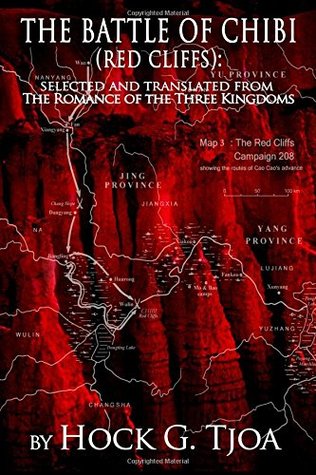
To revive interest in The Battle of Chibi, the first book I published, I decided to do another giveaway through Goodreads. I don't remember having done so for this particular title but thought I should do it (perhaps again) now. Anyone interested should click on the following "widget" from Goodreads. The Giveaway begins in a few days on February 15.


Goodreads Book Giveaway


The Battle of Chibi by Hock G. Tjoa

The Battle of Chibi

by Hock G. Tjoa


Giveaway ends February 25, 2016.

See the giveaway details
at Goodreads.


Enter Giveaway


The Romance of the Three Kingdoms (三國演義) is one of the four great Chinese novels. The other three are The Water Margin (shui hu zhuan/水滸傳 ), sometimes translated as All Men Are Brothers or Outlaws of the Marsh, Journey to the West (xi you ji/西遊記 ), and Jin Ping Mei (金瓶梅)  often translated as The Plum in the Golden Vase. This last title is a translation of the given names of the three main female characters in it but in any case, this novel is often deemed too pornographic and hence substituted for by The Dream of the Red Chamber (紅樓夢). The most recent translation into English uses the title The Story of the Stone as the "frame story" to this classic is that of a sentient stone left over when the heavens and the earth were renovated.

My book, The Battle of Chibi, consists of twenty three chapters or portions of chapters (out of 120 chapters in the Romance) that I translated from the Mandarin in the long fit of boredom that afflicted me when I retired. Unwittingly, I thus embarked on the third act of my working life. The choice was not difficult to make. Although Pearl Buck thought much of The Water Margin and her translation of that work (as All Men are Brothers) is highly regarded, it is to me a tedious tale of banditry. There were 108 of those brothers or outlaws and not much that distinguished one tale from another of a good man driven into such a life by political or personal circumstances. 


Nor was I attracted to the story of the Monkey King and the rivalry between Daoism and Buddhism that makes up the fantasy world of The Journey to the West. An occasional encounter with the paranormal would enliven my reading, and I enjoyed the shenanigans of the Monkey King as much as the readers of the Journey did though I much preferred the very short version published by Arthur Waley as Monkey. My preference is to take paranormal shenanigans in small doses.

The Dream of the Red Chamber mentioned above is another thing, telling of the fall of a family from high society and of young love among many sisters, cousins and aunts. It is also an academic specialization of its own. Scholars spend almost their entire careers in the study of its linguistic or literary nuances, as some might choose to study Shakespeare or Sophocles. It might be worth the trouble extricating the story from such a tangled fate, probably not as a selection and translation so as to avoid the parsing of phrases but as a selective retelling of the story. 

Ah, another project.

Our Story

This review first appeared in Goodreads ,  https://www.goodreads.com/review/show/2491467631 Rao Pingru wrote this charming "graphic nov...